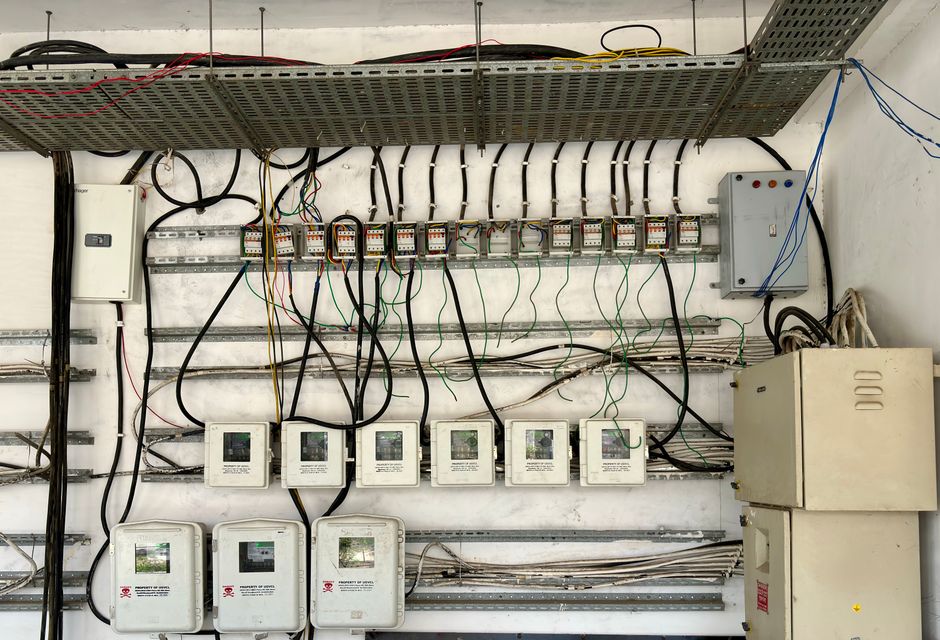
This article is educational and does not constitute professional electrical, financial, or legal advice. Panel work involves live service conductors that remain energized even with the main breaker off. This is not a DIY project — hire a licensed electrician for any panel work.
Electrical panel upgrade cost typically runs between $1,500 and $4,500 for a standard 100-amp to 200-amp service upgrade in 2026, but quotes of $6,000 or more are not unusual once a new meter base, service mast, or utility coordination enters the picture. Few home projects have a wider gap between the simple version and the complicated version of the same job, and few are quoted with less explanation. The panel is the heart of your home’s electrical system, the project is squarely in licensed-electrician territory, and the price depends far more on what surrounds your panel than on the gray box itself. Here is how the number actually gets built, so the quotes you collect make sense instead of feeling like darts thrown at a wall.

Electrical panel upgrade cost: typical 2026 price bands
Most projects fall into one of four buckets. A straight panel swap — same amperage, same location, new box and breakers because the old panel is obsolete or recalled — usually runs $1,200 to $2,500. A service upgrade from 100 to 200 amps, the most common project, typically lands between $2,000 and $4,500 including the new panel, breakers, grounding updates, permit, and inspection. If the meter base, service entrance cable, or mast must be replaced too, expect $3,500 to $6,500. And if the utility has to upgrade its own equipment — the drop from the pole or the underground lateral — that can add anywhere from nothing to several thousand dollars depending on your utility’s policies, a number only the utility can quote.
Subpanels are a separate, smaller project: adding a 60- to 100-amp subpanel for a garage, kitchen remodel, or EV charger generally costs $500 to $1,800. Sometimes a subpanel solves the actual problem for a fraction of a full electrical panel upgrade cost, which is exactly why understanding your real load matters before you sign anything.
What you’re actually paying for
Equipment
A quality 200-amp loadcenter with main breaker costs $250 to $700 at retail, and a full set of new breakers adds $200 to $600 — more if your jurisdiction requires arc-fault (AFCI) and ground-fault (GFCI) breakers on existing circuits, since those run $40 to $120 each versus $5 to $15 for standard breakers. AFCI requirements alone can quietly add $500+ to a quote, and they exist for good reason: the National Fire Protection Association reports that electrical distribution equipment remains a leading cause of home structure fires, and its consumer safety resources at nfpa.org explain the role modern breakers play in preventing them.
Labor
A panel swap is a 4- to 8-hour job for a licensed electrician, often with a helper; a full service upgrade can take a day or more. At prevailing rates, labor commonly represents $800 to $2,500 of the total electrical panel upgrade cost. The electrician is not just moving wires — every circuit must be identified, landed, torqued to spec, and labeled, and the grounding and bonding system usually needs updating to current code.
Permits, inspection, and utility coordination
Permits typically cost $75 to $400. A service upgrade also requires the utility to disconnect and reconnect power, which means scheduling, sometimes a same-day inspection, and occasionally a utility fee. A house can be without power for four to eight hours on upgrade day. None of this is optional: an unpermitted panel is a red flag for home insurers and a common deal-killer in real estate inspections — the Insurance Information Institute discusses how home systems and maintenance affect coverage at iii.org.

The factors that swing quotes by thousands
These variables are what push an electrical panel upgrade cost from the low end of the band to the high end:
- Panel brand and condition: certain legacy panels (notably some Federal Pacific and Zinsco models) are widely considered fire risks and usually trigger full replacement rather than repair. The U.S. Consumer Product Safety Commission maintains recall and safety information on electrical equipment at cpsc.gov.
- Service entrance condition: a corroded meter base or undersized service cable turns a panel job into a service rebuild.
- Panel location: moving a panel (for example, out of a closet, where code no longer allows it) adds wire-extension labor for every circuit — often $1,000 or more.
- Grounding upgrades: driving new ground rods and bonding water and gas lines adds $150 to $500.
- Aluminum branch wiring: requires special connectors and care, adding labor.
- Drywall and finish repair: electricians cut; they rarely patch and paint. Budget separately.
- Region: the same job can price 40 to 60 percent higher in high-cost metros.
Do you actually need the upgrade? Check the load first
The honest answer to “do I need 200 amps?” is arithmetic, not vibes. Electricians size a service with a load calculation that weighs square footage, fixed appliances, HVAC, and large new loads like EV chargers or heat pumps. A 100-amp service comfortably runs many smaller homes with gas appliances; it gets tight fast when electrification enters the picture. Before collecting quotes, run your own rough numbers with our free load estimator for home circuits — knowing whether you’re at 60 percent or 95 percent of capacity completely changes the conversation with bidders.
Electrification is the most common trigger in 2026. An EV charger (typically 30–60 amps), a heat pump, an induction range, and a heat pump water heater can each claim a large share of a 100-amp service. If you’re weighing an electric or hybrid water heater as part of that picture, our guide to budgeting a water heater swap covers how the new circuit fits into that project’s price. The U.S. Department of Energy’s Energy Saver program offers plain-language guidance on home electrical systems and electrification planning at energy.gov, and federal tax credits in effect for qualifying panel upgrades tied to electrification projects may offset part of the price — verify current eligibility rules rather than assuming.
Also worth knowing: smart load-management devices (sometimes called smart splitters or panel-level load controllers, $300–$1,200 installed) can let an EV charger share capacity on an existing service. For some households, that gadget legitimately postpones a multi-thousand-dollar upgrade. A good electrician will tell you when that’s the case; a great one will tell you unprompted.
Warning signs your panel needs attention regardless of budget
Some symptoms move this project from “someday” to “soon”: breakers that trip repeatedly under normal use, a panel that’s warm to the touch, buzzing or crackling sounds, scorch marks or melted insulation, flickering lights when large appliances start, or a panel with no spare slots that’s already wearing tandem breakers in every position. Two-pronged outlets and frequent bulb burnout in an older home suggest broader wiring-era issues beyond the panel itself. None of these is a guaranteed emergency, but all of them deserve a licensed electrician’s eyes promptly — electrical fires give very little warning, and the warning they do give looks exactly like this list.
If your situation is “the panel is old but working,” the decision looks a lot like any other aging-equipment call. Our repair-or-replace decision tool was built for appliances, but the same logic — age, fault history, cost of failure — frames the panel question well. The cost of failure here just happens to include fire, which weights the math considerably.
How to get quotes that mean something
Collect three itemized quotes from licensed, insured electricians, and make sure each one specifies: the panel brand and amperage, the number and type of breakers (and how many are AFCI/GFCI), whether the meter base and service entrance are included or excluded, who pulls the permit, who coordinates the utility disconnect, grounding work, and what’s explicitly not included (drywall repair almost never is). Ask each bidder what they expect the inspector to flag — specific answers signal experience with your local jurisdiction. Be wary of any quote dramatically below the others; in panel work, the cheap bid usually omits the permit, and an unpermitted upgrade can haunt your insurance and your eventual home sale far longer than the savings lasted.
A reasonable electrical panel upgrade cost budget for most homes: $2,500 to $4,000 for a 200-amp project with permit, plus a 15 percent contingency for service-entrance surprises. Get the load calculation first, the quotes second, and the work scheduled before the panel forces the issue on its own timeline.
Disclaimer: This article is for general informational purposes only and does not constitute professional electrical, financial, or legal advice. Prices cited are broad national estimates that vary significantly by region, home, utility, and market conditions, and they change over time. Electrical panel and service work involves conductors that remain energized even when the main breaker is off and can cause electrocution or fire if handled improperly. This is not a DIY project under any circumstances: always use a licensed, insured electrician, obtain required permits, and follow local code and your utility’s requirements.

Elena Park covers home electrical and HVAC topics for coverhub.fun. Her background in residential electrical service work — outlets, breakers, GFCIs, central air conditioning, and the steady stream of small failures that send most homeowners straight to a service tech — shapes the way her guides are written: figure out what’s actually wrong first, then decide whether you’re looking at a $0 reset or a real repair.
Elena focuses on the service calls that most often turn out to be DIY-safe: a single dead outlet that’s really a tripped GFCI two rooms over, a thermostat that’s reading wrong, a clogged AC condensate line, or a frozen evaporator coil masquerading as a dying compressor. She’s just as clear-eyed about the work that does not belong in a homeowner’s hands — anything inside the main electrical panel, any sustained burning smell, any breaker that won’t stay reset.
Each piece on her byline gets a final safety pass before publishing. Suggestions, corrections, and reader questions are welcome at editorial@coverhub.fun.